RIP Brighten English School. You will not be missed.

Nov 27, 2009
End of an Era
Over a year after it should have, our school in Korea finally closed it's doors on Wednesday November 25, 2009.

Nov 20, 2009
Bratislava
Last weekend Jason and I made a little juant down across the border to Slovakia. The capital of the Slovak Republic, Bratislava, is only about 4 hours away from Prague. I only have one class on Fridays and it has been canceled for the last 3 weeks, and Jason only has 2 Friday classes which he was able to reschedule. We knew that we wanted to head to Bratislava at some point while we were in Prague, but we had a little bit of motivation for going on this particular weekend. As you should know, Jason is a big soccer fan. The US national soccer team had a friendly game scheduled to play against Slovakia for last Saturday. So we decided it would be a good time to check out the city. So we caught a 7 AM bus on Friday morning and made it to Bratislava a little after 11.
It's a tiny little capital, but has some nice areas to walk around in the old city center. There are some great pedestrian streets filled with shops, restaurants and pubs. We wandered around for a while and made our way up to the Bratislava Castle, which sits on a small hill overlooking the city. Unfortunately, it is undergoing renovations, so you can't go inside and some of the ground area closed. The main castle building has recently been repainted bright white. Now it looks so new and perfect that you'd think it was some fancy new hotel, not a centuries old castle.
But there were nice views of Bratislava and the beautiful countryside and the winding Danube River. Looking west from the castle, you can see dozens and dozens of electricity generating windmills. Looking this direction you think Slovakia must be concerned about the environment and is trying to do their part to help. Then when you turn to look at the view to the east, you see dozens and dozens of factories with smoke stacks polluting the air. Lovely. I take back my previous statement. You can also see the city's "famous" bridge, the Novy Most, which looks like a UFO is landing on bridge. It's interesting, and clearly from the '70s.
So after a day of wandering around the city, testing Slovak beer (simply for testing purposes, to compare to Czech beer), and a tasty meal, we went to pick up our tickets for the USA vs. Slovakia game. Thanks to some of Jason's soccer connections in the States, we were able to get 4 free tickets to the game. We had to run by the Holiday Inn where the team was staying and meet with the team manager to get our tickets. Before we went, we had all these ideas of how excited the team was going to be that we made it all the way to Slovakia for a game and they were going to invite us to dinner and give us warm ups and a special VIP box at the game. But, surprisingly enough, none of that actually happened. Huh.
We then went to meet up with our wonderful host for the weekend, a very friendly Slovak girl named Dana who we found through Couch Surfing. For those of you who don't know about Couch Surfing..... it's an online community similar to Facebook, but it is specifically for finding people to stay with or meet up with while you're traveling. I know, it sounds like it could be a little sketchy, but it actually seems pretty safe/legit. Everyone has a profile with photos and information about themselves. Then after people stay with them, they write reviews (just as you would review a hotel) for other people to learn about the person. I know there could still be some problems, but it really seems like they're making it as trustworthy as possible. And I think most people who get involved with it are like minded people and really just want to meet other travelers. Anyway, it is a great way to meet locals and save money at the same time. If you're interested, check it out here.
So we met Dana and went to her cute little apartment in one of the many old communist block apartment buildings. Her place was comfortable and we enjoyed staying with her and hearing her stories and getting some great travel advice from her.
Saturday was the big game. Online, we found a group of Americans that were planning on meeting up in a pub in the center a few hours before the game. So we found the pub and met about 15 other Americans there. Most of them were living in England, either working or studying. There were also a few diplomats from Vienna, and even one couple who flew all the way from Chicago to Bratislava for the weekend just to go to the game. Wow. It wasn't even an important game!
We had a good time chatting and getting to know one another before heading to the game in the afternoon. When we got there, we were quickly escorted by a few security guards who showed us to our special Americans section. The security guards stayed with us the whole game, I think we had about 8 of them surrounding the group of 15 of us. The US ended up losing the game, bummer. But we still had fun in our little cheering section, trying and failing to cheer as loud as the thousands of Slovak fans.
For our last day in Slovkia, we took a bus about 15km outside of the city to another old castle, called the Devin Castle. It is completely in ruins now, but you can walk around and stones and get some great views. There are still some towers standing that look pretty cool, and you can imagine what the castle must have looked like in its glory days. It is also right on the Danube River and is only 3km from Austria and about 12km from Hungary. We had warm, perfect weather that day and it was just wonderful to walk around outside.
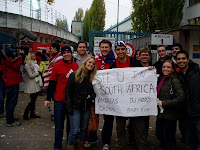
Outside the stadium with some of the American crew.
Nov 13, 2009
Different.
Living in the Czech Republic I find myself comparing my experiences here to those I had in Korea. Clearly there are more cultural differences than I could possibly mention. But most of what I'm noticing is how my interactions with the cultures differ.
In Korea, I obviously did not look Korean. No one ever tried to speak Korean to me and they were never surprised when I didn't understand them. We would get many stares- especially from older people or little kids. Many kids would even stop, point and say to their patents "mi guk!" (foreigner). I got used to life as a minority and not being able to blend with the culture. No matter what I did, even if I learned to speak Korean fluently, I would still stand out as being different and being a foreigner.
In Prague it is completely opposite. I am just another white, European person and look like any other Czech girl walking down the street. My style is similar to Czech fashion, my hair color is spot on, etc. I get stopped at least once a day where someone tries to speak Czech to me. Ask directions, try to sell me something, older people when i give up my seat to them on the tram, whatever. And at the deli when I am buying some lunch meat and the sales person tries to ask me a question and just looks at me like I'm stupid for not understanding something so simple, until they realize that I'm not Czech. In any of these situations there's always the awkward moment when I try to make it clear that I don't understand. "No Czech, English." and this usually doesn't happen until they've rattled off half of what they were tring to say. I hate dealing with these situations and it almost make me miss Korea where no one would talk to me, never even hand me promo fliers in the metro, never have the confused look on their face when I didn't know what they were saying.
I had told myself that I wasn't going to make the same mistakes I made in Korea as far as not learning the language. But now, I'm not so sure if it's going to happen. I had hoped to sign up for a free Czech class through one of my language schools but unfortunately it doesn't fit with my schedule. So I bought a Czech phrase book and decided I would try to learn some on my own. But the pronunciation is so different from English that I don't even know where to start. How do you pronounce "zd" together? And what's the difference between č and c? Û, ú and u?
And it's not only that. While they only have simple verb tenses (no continuous or perfect tenses), they congigate nouns and change endings for masculine and feminine. For example, "Prague" in Czech can be Praha, Praze, Prasky and probably a lot of other versions that I don't even know.
So we'll see how far I get on my own. Many of my students really want me to try learning it and ask about my progress every week. And then just smile and laugh when I try to say anything in Czech.
So, back to my Korea vs. Czech ideas... While it is of course nice to be able to blend and not stand out all the time, when you feel like a stranger in a strange land it is kind of nice to not be confused as something different. And as a white American, I think it was a very good experience for me to spend a year as a minority. But that's a whole other story.
I don't think I'm really going anywhere with this, just observing the differences. So that's where I'm at. I will try to learn some more Czech to make life easier. Maybe I can at least learn "I don't speak Czech."
In Korea, I obviously did not look Korean. No one ever tried to speak Korean to me and they were never surprised when I didn't understand them. We would get many stares- especially from older people or little kids. Many kids would even stop, point and say to their patents "mi guk!" (foreigner). I got used to life as a minority and not being able to blend with the culture. No matter what I did, even if I learned to speak Korean fluently, I would still stand out as being different and being a foreigner.
In Prague it is completely opposite. I am just another white, European person and look like any other Czech girl walking down the street. My style is similar to Czech fashion, my hair color is spot on, etc. I get stopped at least once a day where someone tries to speak Czech to me. Ask directions, try to sell me something, older people when i give up my seat to them on the tram, whatever. And at the deli when I am buying some lunch meat and the sales person tries to ask me a question and just looks at me like I'm stupid for not understanding something so simple, until they realize that I'm not Czech. In any of these situations there's always the awkward moment when I try to make it clear that I don't understand. "No Czech, English." and this usually doesn't happen until they've rattled off half of what they were tring to say. I hate dealing with these situations and it almost make me miss Korea where no one would talk to me, never even hand me promo fliers in the metro, never have the confused look on their face when I didn't know what they were saying.
I had told myself that I wasn't going to make the same mistakes I made in Korea as far as not learning the language. But now, I'm not so sure if it's going to happen. I had hoped to sign up for a free Czech class through one of my language schools but unfortunately it doesn't fit with my schedule. So I bought a Czech phrase book and decided I would try to learn some on my own. But the pronunciation is so different from English that I don't even know where to start. How do you pronounce "zd" together? And what's the difference between č and c? Û, ú and u?
And it's not only that. While they only have simple verb tenses (no continuous or perfect tenses), they congigate nouns and change endings for masculine and feminine. For example, "Prague" in Czech can be Praha, Praze, Prasky and probably a lot of other versions that I don't even know.
So we'll see how far I get on my own. Many of my students really want me to try learning it and ask about my progress every week. And then just smile and laugh when I try to say anything in Czech.
So, back to my Korea vs. Czech ideas... While it is of course nice to be able to blend and not stand out all the time, when you feel like a stranger in a strange land it is kind of nice to not be confused as something different. And as a white American, I think it was a very good experience for me to spend a year as a minority. But that's a whole other story.
I don't think I'm really going anywhere with this, just observing the differences. So that's where I'm at. I will try to learn some more Czech to make life easier. Maybe I can at least learn "I don't speak Czech."
Nov 9, 2009
A History Lesson....
One of the best things about living in foreign countries is learning things that I would never have either the opportunity or desire to learn much about back home. And here in the Czech Republic, teaching well educated adults, I've been given a lot of opportunities to learn about Czech history, mostly from first hand accounts.
As the Czech Republic gets ready to commemorate the Velvet Revolution and the fall of communism twenty years ago next Tuesday, I thought I would take the time to share some insight that my students have shared with me.
One of my students, Pavel, has shared a lot of his experiences growing up in a communistic society with me. He says his father had some trouble with the police because he was involved in some protests in the 60's. Because of this, Pavel wasn't allowed to go to high school. Even though he had some of the best marks of his class and successfully passed his entrance exams, he was told that there was no more room at the school. He was sent to a vocational high school where he learned some trade work and was eventually allowed to attend a regular high school. But this meant leaving his hometown and moving to Prague by himself at the age of 15.
He also told the story of his brother who left their hometown to study in another part of the country. He has to change his last name so no one would know he was related to the family, and Pavel was never allowed to talk about his brother in public.
Students tell me stories of "voting" during the communistic rule. It was reported that 99.99% of the people voted and they all voted for the communism leader. Well, this was obviously because they were given no other options. You had to go to the polling place on the day of the election and fill in the ballot, even though there was only one option. And if you chose to go into a private booth to fill in your answers (such as is common practice now) it would be noted and you would probably be questioned and black listed later.
I have another student, Josef, who told me his memories of the Velvet Revolution. He was actually involved in the revolution and participated by spreading the word throughout the towns and villages around the Czech Republic. He said he would make posters and traveled around the country posting the information to those who were out of touch with the happenings in the big city.
He also remembers the days before the revolution when he was a university student. He says he liked metal bands, such as Metallica, but he was only able to buy their music on black markets and had to be careful about it. Music that was ok'd by the regime? ABBA and Michael Jackson. He also said that some foreign products, like Coca Cola, were available in Czechoslovakia. But they were only in specialty stores which used some certain type of bank notes that only foreigns were able to obtain in exchange for their foreign money.
Now, about 15% of the Czech population still supports the communistic party. Who makes up this 15%?, I ask. Older, poor people is the answer. The small part of the population that actually benefited from communism.
Even though the Czech Republic is traditionally a Catholic country with beautiful cathedrals littering the countryside, there are very few people practicing religion today. Only about 25%. And in Prague, I hear it is even lower, more like 10%. I think this has to be one of the most - if not THE most- unreligious cities in the world. When I talk to some of my students in their 20's about religion, they say that they don't know a single person who attends church and believes in God. One student says she "goes to church" occasionally. When I ask her more about it, she says that she goes to see the cathedral, not to attend mass. Maybe she will attend mass on Christmas, she says. But she describes that mass as not being religious, more just well wishing for everyone. Surely much of this is due to the cummunistic rule that was in place for decades and did not allow religion. But, there are other countries that have been under communism for just as long. So what makes the Czech Republic different? I'm still not sure...
In one of my classes the word "confiscated" came up one day. When I tried to check my students' understanding of the word, I got a little bit of laughter along with this response: "If you've ever lived in a communistic country, you know the meaning of the word confiscated."
While most people I speak with seem to feel very strongly about communism and there are clearly still fresh wounds there, I have one student who doesn't seem to care too much. She says she thinks very few people's lives were changed by the fall of communism. Most people's everyday lives are the same as before, she says. But, I think she might be in the minority on this. While it's probably true that most people's lives didn't immediately change, I think everyone will cite plenty of differences between their past lives and today.
Oct 31, 2009


Oct 30, 2009
Life in the CZ
Okay, I know I've been a little behind about writing about life in Prague. We haven't had properly functioning internet at home until now, so it's been hard to update. But I really do want to keep u with my blog a little better, so it's my goal to write more on here. Starting..... NOW!
Life is Prague has definitely been a little crazy. Getting settled here has been much much more of a challenge than the other countries we have moved to (Peru and Korea). In Korea, we had everything settled before we even left the US: jobs, work visas, apartments, etc. In Prague, we came with NOTHING. All we had was a hotel to stay in for the first four nights and some names of schools to start sending our resumes to. So when we got here, we hit the ground running.
Luckily, we found an apartment after about 3 days. We met a nice British guy who worked at the hotel we were staying at (he has since become a good friend here) and asked him for any tips on getting settled here. He just so happened to have a friend who was moving out and needed to sublet his apartment for a while. Perfect! The apartment was in a really nice area of Prague, but a little far from the center. It was also pretty old and not the nicest place ever. But it was fine. But after a couple months of living there, we decided we needed something new. And the guy we were subletting from was planning on moving back in in January. So we had to find a new place eventually. We found a really nice apartment closer to the center and closer to a metro station and just moved in three days ago. The only trade off was that we couldn't afford to live in a central location by ourselves. So we are sharing a place with two other American girls, both teachers as well. The apartment is big, recently redone so everything is nice and new, and we have a nice big bedroom on the 5th floor with a little view! Life is good.
We started going on job interviews our second day in the city and landed our first offers after about a week. Like everywhere else in the world, the Czech Republic has been affected by the financial crisis (although not as much as many of it's neighboring countries). Because of this, we realized we were most likely not going to be able to find full time jobs. We both ended up getting two part time jobs, which leads to plenty of work. Jason and I both work at a small language agency and then we each have separate jobs at two bigger schools.
I use the term "school" loosely here, as very little of the actual teaching is done in the school. The majority of classes in the Czech Republic are taught 'in company', meaning a language teacher is sent out to various companies around the city and teachers individuals or groups in their own company. So, I spend my days running around all different parts of the city. I go everywhere from the very heart of Prague to places that I don't think are even technically considered to be part of Prague. This definitely was a little crazy at first, figuring out everywhere to go and how to get there, but after a few weeks it became pretty easy to get it down. All of my classes are once a week, so my schedule is different everyday. On some days (like Wednesday, my easy day) I just have one class in the morning and one in the evening. Lots of free time during the day to plan for classes, come home and relax, etc. However on other days (like Thursday, my busy day) I go non-stop from 8am to 6pm - 5 classes that day.
I have almost all individual classes and most of my students are at a pretty high level. So I have a lot of conversation classes where we spend our time just talking about various topics. I have a lot of students that are very interesting people and make my classes really enjoyable. I learn a lot about Czech culture, food, history, etc. from them. A lot of my students have very interesting jobs, and it's a good experience for me to get to talk to all these successful and different people. I teach everyone from a high school aged model, to the owner of a media production company.
And as for the visa process...... still working on it. Jason is further along on his than I am on mine, and we're getting different types of visas. Coming here, there was so much mixed information, it was really hard to figure out what our best options were and how we should go about doing different things. One of the big questions we had was about the visa. You can choose to get either a regular employment visa or a business license (Zivno). The advantages of the business license is that you don't have taxes taken out (you're supposed to be able to keep more of your money with the Zivno) and you have the freedom to work how ever many jobs you want. I got convinced to do the Zivno, so I'm in the process of doing that. I have to go to Germany on Friday to apply for the visa at the embassy, so we'll see how that goes...
Only problem with the Zivno that we're just learning about, is that I may not be able to leave the country for quite some time. It has a long processing time - several months- and until it's finished being processed, I'll kinda be here illegally as far as I understand. So if I were to try to leave the Czech Republic and come back in, my tourist visa would be expired and I might not be able to do it. This is going to be a problem for Christmas when we have two weeks off and were hoping to travel to some warmer countries... Border patrol is pretty lax in these parts, so we may just be able to go somewhere by bus or train where we won't be stopped and have our passports checked. We'll see!
So that's life here in Prague. Who's coming to visit!?!
Oct 27, 2009
But What Does It All Mean!?
In Korean:
Ne = Yes
Anio = No
In Czech:
Ano = Yes
Ne = No
You see my confusion? After a year in Korea I got the words so ingrained into my mind that I'm having a lot of trouble changing it. I usually find myself in shops saying no (Ne) but nodding my head yes. I know I'm confused and I can't imagine how the poor shop keepers feel.
Also, to indicate the number one, I am used to holding up my index finger as we do in the States. However, here, that means two. One is indicated by your thumb.
So, here I am in a shop trying to buy.... let's say, a croissant. I say "one," hold up my index finger, nod my head "yes" and say "Ne". The shop keeper just stares in udder confusion.
Who knew a simple task could be so confusing?
Subscribe to:
Posts (Atom)